
Driving for Work: Mythbusters
52 common misconceptions – and the facts employers and drivers need to know
Myth 44: As long as equipment is in the van, it doesn’t matter how it’s loaded
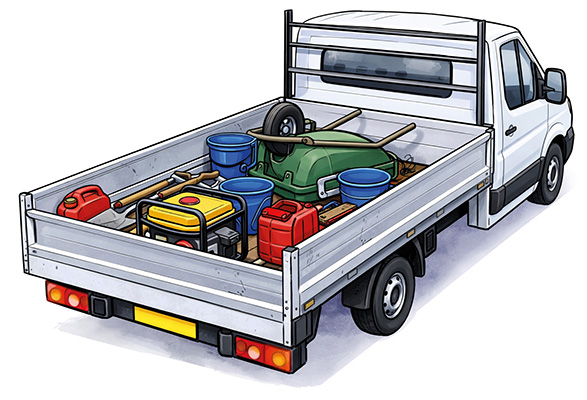
This is a dangerous assumption. Safe stowage is not simply about what goes in the back – it is about how items are positioned, secured and monitored throughout the journey, whether they’re in the back of a closed panel van or outside in a dropside LCV.
Ladders and equipment carried on the exterior of a vehicle must be adequately secured at both front and back using appropriate fixings; if they come loose at speed, they become potentially lethal projectiles. Equipment carried inside the load area must be secured so it cannot slide forward under braking, shift sideways on corners, or topple onto the driver.
Thousands of road incidents occur each year due to objects falling from vehicles, and drivers can face fines of up to £2,500 and three penalty points if any part of the load is unsafe or insecure. Drivers should listen for rattling during the journey as an early warning that something has worked loose and pull over safely to check and re-secure before continuing.
Employers must ensure drivers have the right equipment, including load restraints, straps, and racking, and are trained to use it correctly. Taking risks when transporting equipment on the exterior of a vehicle is not only dangerous, it can also be illegal.
Driver takeaway:
Safe stowage is your responsibility throughout the journey — not just at loading.
Listen for rattling, check securing at every stop, and never move off if you are unsure your load is properly secured. You are legally responsible for what your vehicle carries and how.
Manager takeaway:
Provide drivers with the right equipment — racking, straps, load restraints — and train them in how to use it correctly.
Do not allow time pressure to create a culture where loading is rushed. Thousands of incidents each year involve objects falling from vehicles; most are entirely preventable.