Introduction
Organisations using vehicles for business usually invest a lot of time and effort into ensuring the roadworthiness of the vehicle – but do they spend enough time ensuring that their driver is fit to be behind the wheel? Vehicle roadworthiness is essential, of course – but the fact remains that, in most cases, it is not vehicles which cause collisions but rather the human beings driving them.
Your driver's physical health, state of mind and mental wellbeing has a profound effect upon their safety when driving.
This guide will show you how to assess and maintain driver roadworthiness, the potential problems drivers may face, and what you should do to make sure your drivers remain fit and focused behind the wheel. In doing so, you will lower your collision risk.
We have asked leading academics and relevant experts to be your guide to the various aspects of physical and mental health, as well as the culture of psychological safety you need so that people feel safe in voicing concerns.

Investing in your drivers' welfare will help you to fulfil your statutory duty of care, which includes protecting your employees from physical and emotional harm and protecting them and other road users from road risk.
It will also bring substantial benefits to your organisation including:
- lowering your collision risk
- lowering vehicle damage, third party claims, insurance premiums and unexpected downtime
- higher productivity
- better staff retention, with lower absenteeism and presenteeism
- lower levels of sick leave
- a more engaged workforce
- brand and reputational enhancement and protection
Who is this guide for?
Every director of an organisation which uses vehicles, and anyone who manages those using vehicles, should read this guide and ensure that the organisation has a process for identifying, addressing and supporting driver health issues. This includes those in board-level, health and safety, human resources, fleet and operational roles.
Driver roadworthiness should be embraced as a priority at board level by directors who lead by example. Safety is cultural as is protecting human health.
Your expectations of driver fitness and the steps managers must take to identify and resolve problems should be recorded in your driving for work policy. This should be shared with every manager and driver in your organisation.
Road risk and driver fitness
The Safe System looks at transport from a safety-first perspective. It acknowledges that people make mistakes, and so the design of vehicles, systems, roads, and the routes taken, should be reviewed to support people in driving safely and compliantly.
The Safe System also requires looking at the drivers themselves, because their poor decisions contribute to or cause collisions that can result in serious injury or death.
Telematics and camera systems have given fleet managers a clear opportunity to identify driver errors and violations. Most managers are also aware of the fatal five behaviours:
- failure to wear a seatbelt
- excessive speed
- drink and drug impairment
- mobile phone use
- careless driving
And yet fleets have struggled to eliminate such behaviours. Many interventions, such as debriefs, training, penalties and disciplinary action, do not work with all drivers or only work in short the term. And, sometimes, an otherwise compliant driver can become erratic or risky despite knowing, and usually doing, better.
This failure to change behaviour is frequently because we focus on the behaviour itself and not its cause. The fundamental causes of risky driving are usually unrelated to an individual's skill with the vehicle or even their knowledge of what 'good looks like' but rather their underlying state of body and mind.
We need to ask why a driver is behaving in an inappropriate or risky way.
That fundamental cause – the why of poor driving – will often relate to one of the topics in this guide.
These are just a few of the things which can send otherwise safe and competent drivers' behaviours completely awry:
- Organisational stress and poor planning
- Emotional upset, worries, stress
- Sleep disorders or deficiencies
- Cognitive bias or a skewed perception of risk
- Mental health issues
- Symptoms of disease and illness, pain or worries about health
- Poor physical fitness and stamina
- The effects of prescribed or self-administered medication
- Poor hydration and poor nutrition
These issues are often related and coincide with or cause one another. For instance, a tired driver is more likely to make decisions based on emotion rather than rationality; to seek distraction; and to have poorer observational and processing skills. Poor nutrition and dehydration can cause fatigue and slow reactions etc.
Organisations which address these problems at an individual, policy, and organisational level can therefore achieve huge benefits in lowering their collision risk, protecting their employees and boosting productivity.
The driver demographic
Drivers come in all shapes, sizes and roles. Some sectors may have predominantly male drivers especially in the van and HGV-using sectors. However, the importance of driver welfare extends to everyone who drives for business, regardless of what vehicle they drive or their sex.
Therefore, managers must consider all their employees who may travel between locations, even if they are using their own vehicle. This could include roles such as salespeople, trainers, medics, directors, inspectors or auditors, or care providers.
When we look at the 'traditional' road transport fleets, such as HGVs and vans, the driver risk profile is high. 65% of UK HGV drivers are 46 or older and 36% are more than 55 years old.
Most vocational drivers are male. Male drivers tend to have a higher collision rate than women (even when adjusted for mileage). Men are also less likely to voice personal concerns or seek professional or medical help.
Arguably, therefore, the HGV/van/bus driver community is more at risk of undetected or untreated health conditions than other sectors.
Driving is also not a health-enhancing activity. It tends to involve:
- long periods of being sedentary
- poor access to toilets, good nutrition or adequate chances to rehydrate
- social isolation
- high levels of organisational and road stress
It is probably for these reasons that van drivers have a 25% higher suicide rate than the national average and HGV drivers 20% higher.
Different age groups and demographics may have a higher risk for certain issues than others. This can be reflected in your risk assessment.
The cost of poor employee health
In July 2024 the Institute for Public Policy recorded the cost of employee sickness at £103bn, £30bn more than in 2018. This increase is mainly not caused by people taking more sick days but rather working despite being sick. This is particularly dangerous if the employee has a safety-critical job component such as driving.
Almost three million working-age people are economically inactive due to long-term sickness according to Office of National Statistics data for Q4 2024.
The Centre for Mental Health says that poor mental health is costing the UK £300bn every year – that's equivalent to the cost of an annual pandemic.
According to Deloitte £51bn of that is borne by employers.
The cost of increased road risk is unlikely to be accurately reflected in these figures, but that too has a high financial cost, including injury, mental trauma, fatalities, insurance claims, vehicular damage, disappointed customers and reputational loss.
The good news, says Deloitte, is that for every £1 spent on supporting the mental health and wellbeing of their workforce, employers see a £4.70 return in increased productivity.
Your responsibilities
You have a statutory duty to ensure:
- that anyone driving on business for your organisation is fit to do so in mind and body. To fulfil this requirement you may need to go beyond the minimum steps explicitly stated in law
- that you conduct risk-assessments of those physical, mental and emotional issues which may affect your drivers' safety on the road – and the process by which you will mitigate these risks
- that you take all reasonable steps to protect workers and the public from risk including work-related road risk
- that drivers have declared any notifiable condition to DVLA – and that you have addressed the implications, potential consequences or reasonable adjustments which this condition may involve
- that drivers have regular sight tests, meet the minimum eyesight standard for driving and have corrective lenses where necessary and that any other medical condition which is suggested by their eye test is followed up
- that drivers who are required to have a check-up, do so and are passed as fit by an appropriate medic. This includes drivers with a commercial driver's licence, such as HGVs, coaches, buses, and taxis, or those with medical conditions such as diabetes, epilepsy, and heart conditions
- that drivers are not taking any medication or substance, whether prescribed, over the counter or recreational, which could impair their ability to drive, and that they understand the long-lasting effects of alcohol or other substances which they may consume off-duty
- that you protect employees from work-related stress
This guide will help you to fulfil your statutory duties, to have a happier, healthier, more productive driving workforce, and to protect your drivers and other road users from work-related road risk.
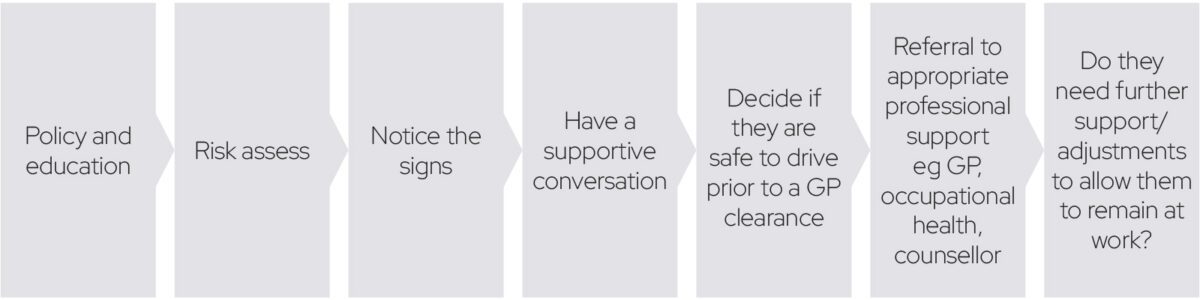
What a good driver roadworthiness process looks like