
Mental Health
With thanks to Dr. David Crepaz-Keay, Head of Research & Applied Learning at the Mental Health Foundation
National Highways fleet engagement programme, Driving for Better Business has a dedicated Driver Wellbeing Toolkit to help with managing at-work drivers. Therefore, this guide has included only a brief mention of the most common issues for completeness.
Mental health is informed by our state of physical and neurological health, lifestyle choices, genetic predispositions and social circumstances. Like our physical health, our mental health requires ongoing care and awareness. Employees must feel safe to ask for help if they have concerns about their mental health.
Although some of the stigma around mental health conditions has been dispelled by recent campaigns, many people may still feel vulnerable or ashamed to admit that they are struggling mentally or emotionally. This may be especially true of middle-aged men, who make up the bulk of the UK working-driver population.
We all need to acknowledge that our minds and brains can suffer illness or strain just like any other part of our body. While support, lifestyle changes and treatment can often help, 'attitude' alone cannot cure mental health problems any more than it can cure heart disease.
Effect on road safety
There are many mental health conditions and individuals may experience those conditions differently. Broadly, however, mental health conditions can distort how we feel about ourselves and the world around us, how we perceive and react to risk, and the level of rationality, practicality or realism involved in our decision-making.
This means that driving is an especially hazardous activity for anyone with untreated mental health issues, as their perception of their on-road behaviour or on-road risks can be highly skewed.
Annual population survey – regional – occupation (SOC2020) by sex by employment type, England and Wales Oct 23 – Sept 24
Most of the professional drivers in the UK are male.
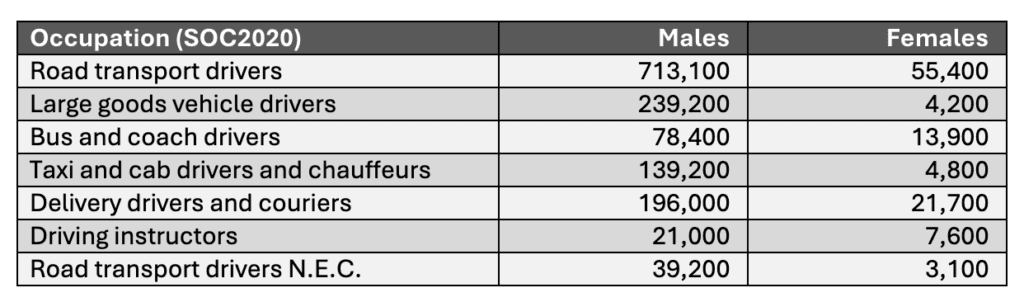
Driving is not only a high-stress occupation but also socially isolating. HGV and van male drivers were found to be at significantly higher risk of suicide than males in other sectors.
It is impossible to know how many collisions are in fact suicide, or attempted suicide, although it is estimated that at least 50 road deaths a year are probably suicides.
Equally drivers of heavy vehicles may find themselves used as the instrument of suicide, with other road users or pedestrians deliberately targeting their vehicle. This can be emotionally and mentally devastating to the surviving HGV or bus driver.
Drivers with mental health problems are also more likely to self-medicate, which can lead to intoxicated driving, and to have poor self-care which can lead to fatigued or impaired performance.