Psychological safety

With thanks to Tom Geraghty, founder of Psych Safety
If we are to manage the risk presented by drivers' physical conditions, lack of sleep, stress or mental health issues, then we need to create an environment in which it is safe to volunteer and discuss that information. This means making the workplace a 'psychologically safe' environment.
Psychological safety means having the belief that you won't be punished or humiliated for raising concerns, asking questions, or volunteering information or ideas. It means building an environment of trust, in which we are safe from negative consequences, even if we are admitting a mistake or raising a concern.
This is essential when we are talking about health or wellbeing in relation to driving. It can take courage for a driver to admit that they haven't had enough sleep or that they feel too unwell or stressed to drive. It takes trust for a driver to share medical concerns which they feel may impact their ability to drive, because they may be afraid that they're talking themselves out of a job.
There are three points that we should bear in mind:
- If a driver has any safety concerns, we absolutely want them to share that knowledge rather than keep it hidden. The worst time to find out is after an incident.
- Addressing medical or mental health concerns early, leads to better outcomes medically and in terms of job adjustments, than waiting for the situation to become more serious. Early diagnosis and treatment saves lives and limits the impact of disease – but, for an employer, early knowledge gives you time to adjust, to plan, to support and to keep that person in their role or a more suitable one, rather than facing long-term sick leave.
- The highest performing teams are the ones who feel safe to speak up. This was demonstrated in healthcare (by Amy Edmondson) but holds true to all industries. Early voicing of mistakes and concerns lets us resolve, manage and learn from what happened. Workplaces where people feel unsafe about speaking up develop a habit of secrecy and blame-avoidance, which means issues aren't fixed, people take more risks and safety outcomes are worse.
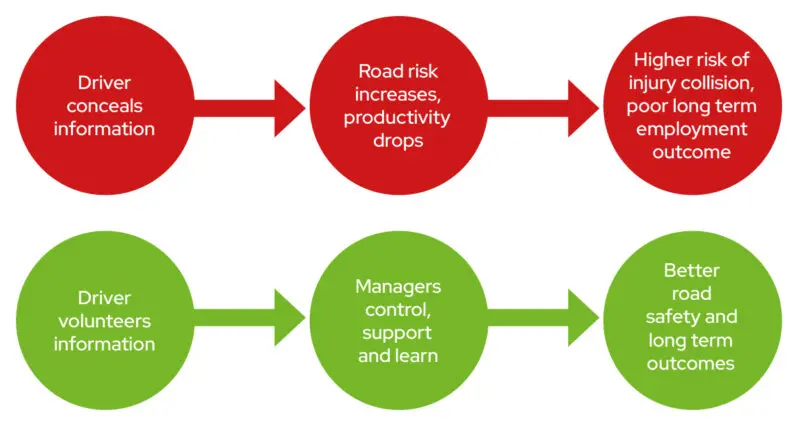
So, although it may be inconvenient if a driver says they aren't up to driving, managers must believe that the company is far better off knowing, and thank the driver for speaking up, however difficult that may feel in the moment.
The benefits of psychological safety
As well as a reduction in incidents, companies that work to foster psychological safety tend to have better employee retention, less absenteeism and less presenteeism. Presenteeism is particularly dangerous for road safety because it means people may work through illness or other problems, regardless of the impact on their driving ability or judgement, increasing their road risk.
Impact on stress
Many studies have shown that having a supportive and psychologically safe workplace lowers employee stress levels. We need to be able to speak up about concerns such as workload, workplace conflict, or a training and development need, if we are to be able to do anything about them. You can't fix a secret.
Learning culture
Psychological safety must co-exist with accountability. Indeed, greater accountability fosters greater psychological safety. We all need to abide by laws and act professionally. However, no amount of professionalism and accountability will completely prevent mistakes from happening. People will always make mistakes because it's part of being human, and learning from mistakes is part of that accountability to always improve. It helps, therefore, to shift focus from 'who's to blame?' to 'what can we learn?'.
This approach also lends itself to incident investigation. Investigating near misses or collisions is essential in order for organisations to learn from them, and therefore to lower their on-road risk. Shifting from 'blame' to 'learning' allows everyone involved with the journey to honestly disclose the messy details of what really happened and examine what could be done differently to prevent it happening again. A problem that remains with whoever found it, is a problem that remains a risk.
How to create a psychologically safe culture
- Train managers in creating a psychologically safe environment. It must be embraced all the way from the people at the "top" of the organisation, to people at the sharp end of work.
- Reward speaking up. If someone admits a mistake or raises a concern, react positively and thank them for doing so. We don't need to pretend to be happy that a mistake was made, but we can be thankful that we've found out about it.
- Use some of the techniques and resources we have included below, in order to encourage people to speak honestly and to contribute. As in the 'human factors' section, employees who can contribute their observations or knowledge, and feel their professional expertise is valued are more likely to engage with work initiatives.
Techniques
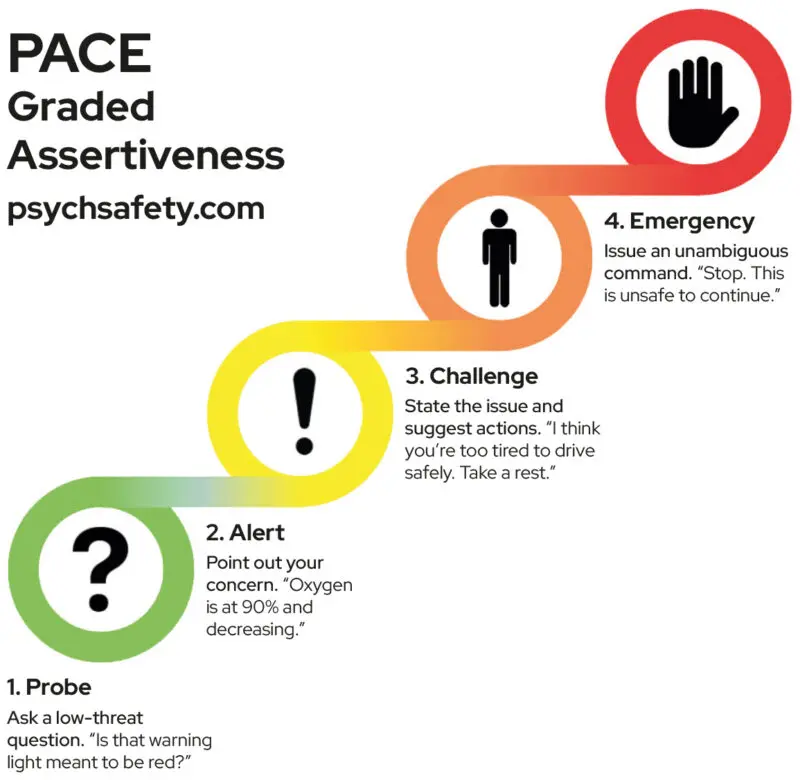
Graded assertiveness – PACE
How to challenge a colleague if you believe they or their action may be unsafe.
PACE stands for Probe, Alert, Challenge, Emergency.
For example, if a driver appears too tired to go out in a vehicle, a colleague could go through the following stages to challenge them:
Probe: Are you OK?
Alert: You seem really tired. Are you sure you are safe to drive?
Challenge: I don't think you should be driving when you are this fatigued.
Emergency: Stop, we'll find another solution.
This gives the tired driver many opportunities to acknowledge their fatigue and suggest they do not drive, without losing face, before being ordered or a manager alerted.
The more PACE is used in the workplace the more people will start to recognise the steps and respond constructively to that first probe, because they realise that their colleague is concerned.
Just Culture
Collisions and disasters are often the result of many contributing factors. A Just Culture looks at all the aspects of managing that journey, not just the actions behind the wheel in the moments before the collision. Focus on investigating what the company can learn and what changes can be made, rather than finding someone to blame.
Lean coffee
Great for getting drivers involved in decision-making. Before toolbox talks or team meetings, ask for notes (real or virtual) to be stuck on the board as potential discussion topics. Take a vote on which topics are most pressing – with each person voting for their top three topics. The topics are then discussed from most-voted to least-voted. Set a timer to limit the discussions and invite the creator of the topic to lead the discussion if they want.
Think Pair Share
This is a great technique to ensure inclusivity in meetings or briefings. Rather than asking a question and listening to those who think fast and talk readily, ask for a minute's silence to consider the question. Then ask people to discuss it in pairs and then report back to the room in their pairs. This helps to capture all thoughts and contributions, not just those of the most vocal.
Avoid the empty gratitude phrases and offer something meaningful
We've all heard managers say, "thank you for your contribution, X", with the sub-text of "please shut up now because I am no longer listening". Just because something sounds polite doesn't mean it is honest, constructive or psychologically safe. If a safety contribution is unwelcome, ask yourself why. If it requires thought, say so. If the company cannot act on it, for a legitimate reason, say so. All concerns need a thoughtful and honest response if we want to hear future ones.
Resources
Low cost-toolkits and training are available from Psych Safety.
Learn more about psychological safety: psychsafety.com/about-psychological-safety/
Free resources can be found here psychsafety.com/free-resources-on-psychological-safety/
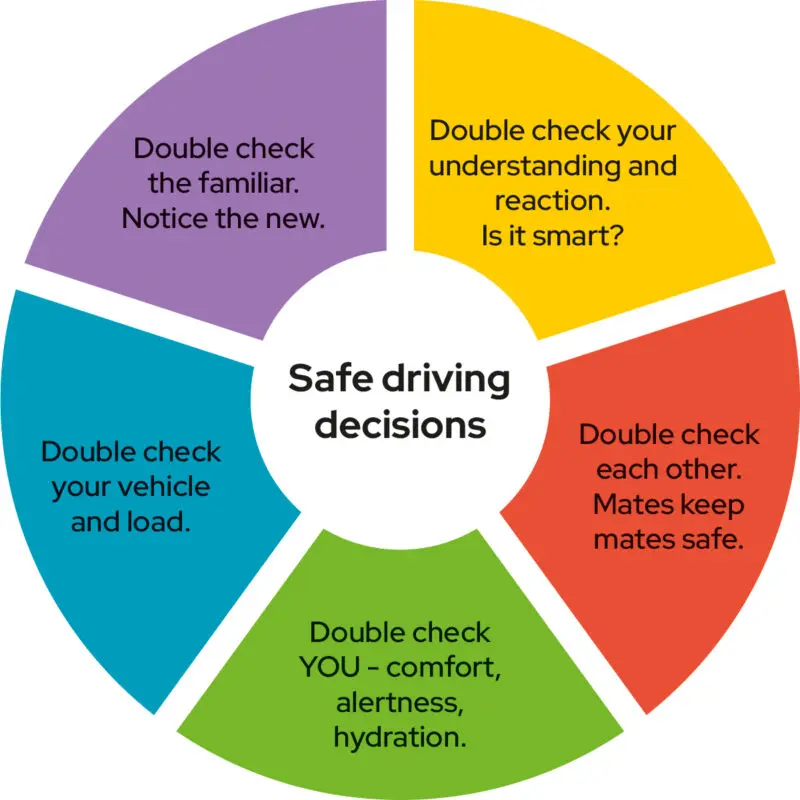
The double-check system
In conclusion drivers are people, and as such are likely to make assumptions, hold back concerns, respond emotionally as often as rationally, overlook the familiar and so miss the new. The more often we do something, good or bad, useful or not, the more those behaviours become ingrained as a default.
One way to challenge this in ourselves is the 'double-check'. Teach drivers to double check themselves, their vehicles, the road situation, their responses – and, if necessary, one another's decision-making