Driver safety at user worked level crossings
in association with
There is a rising trend of serious incidents, collisions and near misses involving delivery drivers at user worked level crossings.
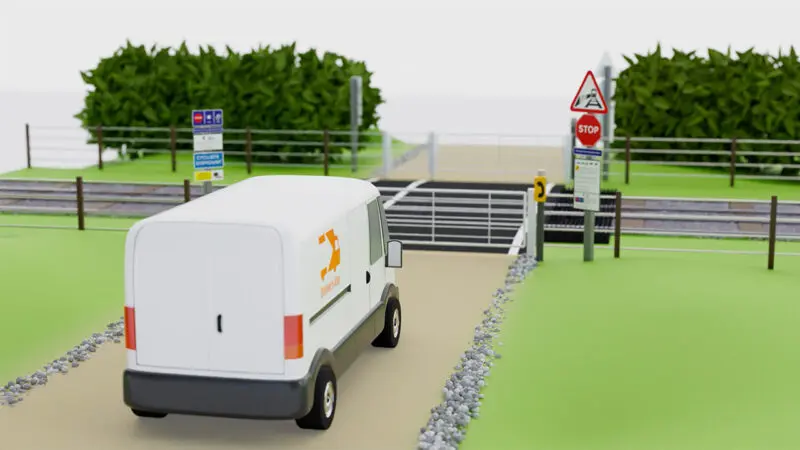
Most drivers are familiar with level crossings on public roads, where warning lights and barriers operate automatically. User worked crossings, which are typically found on private roads or farm tracks are encountered less frequently and may therefore be less familiar.
Together with our partners at Network Rail, we’re urging all companies with delivery drivers to raise their awareness of user worked level crossings, and to promote the safe use of all level crossings, whether on public or private roads.
Footage of level crossing misuse kindly made available by Northern Railway
The risk to your business
Severe safety risk for your driver, the train driver and rail passengers
A collision at a user worked level crossing can expose delivery drivers, train drivers, passengers and other railway users to significant harm, including life changing or fatal injuries. The consequences can be long lasting for everyone involved and their families, colleagues and wider communities. Key risks include:
- Delivery driver: extremely high likelihood of fatal or life‑changing injury due to the speed and mass of a moving train; risk of being trapped in the vehicle; psychological trauma if they survive.
- Train driver: risk of serious injury from derailment or cab intrusion; high incidence of long‑term psychological trauma following level‑crossing collisions; potential career‑ending impact.
- Train passengers: depending on speed, load and derailment potential, passengers may suffer injuries ranging from minor to catastrophic; in worst‑case scenarios, mass‑casualty events are possible.
Such incidents can also result in major investigations and potential prosecution under health and safety at work or corporate manslaughter legislation.
Significant financial losses
Even where insurance is in place, businesses may face substantial costs following an incident. These can include claims for damage to trains and rail infrastructure – such as track and signalling – as well as liability for downtime costs charged by Network Rail.
Regulatory scrutiny and risk of prosecution
A rail-related incident is likely to trigger involvement from the Health and Safety Executive, the Rail Accident Investigation Branch, Network Rail, and the British Transport Police. Investigations may look at whether suitable and sufficient training was provided, whether risk assessments were carried out for routes involving level crossings and whether appropriate management systems and controls were in place. Failures in these areas could lead to improvement notices, enforcement action and long-term operational oversight.
Operational disruption
A collision can have significant operational consequences for a business. Employees may be absent due to injury, trauma or involvement in investigations, while the wider workforce may also be affected by the impact of the incident.
Vehicles may be damaged or taken out of service, affecting delivery schedules and service commitments. Businesses may also need to review procedures, support investigations and implement corrective actions, creating further delays and increasing the risk of contractual penalties, missed deliveries or service failures.
Reputational damage
Rail incidents can attract significant media attention and public scrutiny. This can damage a brand’s reputation, affect relationships with customers and suppliers, and influence future opportunities. Businesses may also face increased scrutiny from clients, procurement teams and suppliers.