Human Factors

With thanks to Dr Lisa Dorn, Associate Professor of Driver Behaviour and Director of the Driving Research Group at Cranfield University and founder of PsyDrive.
Human factors applies theory, principles, data and methods to understand how humans interact with elements of a system. To improve work-related road safety, Human Factors specialists focus on how people interact with vehicle systems, road and traffic systems and the organisational systems in which they work. Human Factors specialists investigate how those systems contribute to people making mistakes or breaking rules and design ways of reducing human error by ensuring that drivers are not forced to operate in an uncomfortable, stressful or dangerous way. Drivers are, first and foremost, human – and as such their decision-making is governed by their psychology, biology and neurology. Or to put it simply, their minds, bodies and brains.
As humans, our performance changes depending upon our circumstances. Fleet managers may well be able to see that a particular driver is performing more poorly on the road through telematics or camera data. However, a briefing which tells the driver to perform better will likely be ineffective unless managers and drivers first understand why he or she is committing errors and violations.
This is why skills-based training of high-risk drivers can have limited effects – because their risky behaviour is often not the product of a lack of knowledge or skill but the factors arising from their personal characteristics, emotional state and the nature of the journey.
Human factors considers a range of topics that can affect driving performance including the effects of:
- stress – traffic congestion and time pressures predict aggression, irritability, frustration and collision involvement, as well as non-work factors
- cognitive workload – some driving tasks are more demanding than others; and attempting a secondary task like using a hands-free mobile phone will cause a drop in driving performance
- distraction – looking away from the road for even very short periods of time significantly increases collision risk
- fatigue – at work drivers are often required to drive for many hours a day and fatigue is a major cause of serious and fatal collisions
- attitudes to and perceptions of risk – for example, our attitude to seatbelt use will determine whether we choose to use them on every journey
People drive differently when they drive for work compared to when they are driving on a personal journey. This can be for many reasons: their attitude to the vehicle or task is different; that their focus is on their work task, to the detriment of safety performance; that they take greater risks with a company vehicle than with their own; people may be more likely to continue to drive for work despite feeling tired, stressed or unwell than they might be if the journey was entirely voluntary or recreational.
Studies have found that people driving for work are at greater risk of being involved in a collision when driving for work than when they are driving their own vehicle.
Cognitive workload
Driving requires a wide variety of cognitive skills: hazard perception and detection, navigation, executive decision-making, information processing, visual processing, memory, and motor (movement) skills.
Driving is a heavy cognitive load for our brains. Junctions in which streams of traffic intersect are particularly demanding for our brains to process and one of the main reasons why junctions are hazardous. Driving requires sustained concentration, because the hazards around us change far more quickly. We have not previously learned to adapt to moving at speed in our evolutionary journey. Humans have evolved to freeze, run away or fight at the sight of a predator and respond to hazards in our environment, but we have not developed these skills while moving at 60 miles an hour.
Distraction
Our brains do not multitask beyond basic biological functions. So if we read a text our brain uses our visual processing, memory and language centres to decode and respond to that text. It cannot simultaneously process visual and other information coming from the world around us.
What's more, it takes time for our brain to switch task – a University of Utah study in 2015 found that it could take up to 27 seconds for the brain to start processing driving information again after giving voice commands or reading a text.
When travelling at speed that 're-tasking time' represents significant distances travelled by the vehicle with, effectively, no one in control.
This means our brains need to be dedicated to driving. Distraction can be fatal.
According to the Royal Society for the Prevention of Accidents, in 2022 2,616 road collisions were directly attributed to in-vehicle distraction. 76 of them were fatal collisions. However, this almost certainly under-estimates the true role of distraction in collision causation, as it is often hard to detect at the scene of a collision. And it is virtually impossible to prove internal distraction, such as worries, pain or anxiety.
Emotional regulation and anxiety
Although stress will be looked at in detail elsewhere in this guide, it cannot be over-emphasised that when people are stressed, highly emotional or anxious, their brains cannot safely perform the functions needed for driving.
Stress changes our entire physiological state, tunnelling our vision and our thoughts. It increases blood flow to the muscles and heart, and incites one of three basic responses: flight, fight or freeze. None of these responses are useful or safe when driving.
Anxiety often provokes constant internal distraction, raises our stress levels, and makes the person incapable of focusing calmly on the task in front of them.
Finally our emotions – whether elation, anger, frustration, or fear – also affect our decision-making profoundly.
Emotions originate in the amygdala, two tiny lobes in the brain sometimes called the 'drama almond'. During strong emotions the amygdala can 'hijack' the brain entirely, bypassing the rational, problem-solving areas. Impulse control, rationality, perspective, accurate perception are all kicked to the kerb. Toddler tantrums, crimes of passion, and red-mist rages are all examples of amygdala hijack – but it happens in far less spectacular ways as well.
Creating behavioural change
Managers need to know how to achieve behavioural change, not only in driving behaviour but also in some of the underlying issues which may present a driving risk. How do we ensure that a tired employee gets more sleep? How do we encourage healthier lifestyles, or less distracted driving?
Insight training aims to develop attitudinal and motivational competencies and to raise drivers' awareness of factors that contribute to collisions and of the potential risks when driving. For example, it is well known that drivers overestimate their driving skills and consider themselves to be more skilled in driving than their peers and less likely to have a collision than their peers. In one study up to 80% of drivers considered their driving ability to be 'above average', which is statistically unlikely.
This is referred to as 'Optimism Bias' and has been associated with increased risk-taking and collision involvement. Driver education can help drivers to develop self-knowledge about the role of motives and how it can affect their driving decisions. Research shows this can improve self-regulation and self-monitoring skills and lead to lower collision rates for at-work drivers (Gregersen et al, 1996).
Profiling personality-based emotional responses to driving is a proven method to develop driver knowledge about the strengths and weaknesses they bring to their driving (Dorn et al, 2010). Profiles can then be used for one-to-one coaching conversations, group discussions and workshops.
Motivation
Motivation can be intrinsic – satisfaction, a sense of professionalism, a sense of purpose, camaraderie or engagement – or it can be extrinsic, such as a bonus, or an employee award.
Internal or intrinsic motivators are more sustainable. We know that the keys to achieving employee buy-in are autonomy, mastery and purpose.
Autonomy: People like to feel in control of what they do. Some drivers may not have much autonomy over where and when they make a journey. However, everyone can have autonomy in terms of contributing opinions, feedback, and sharing their experiences. Potentially drivers can be involved in decisions about which vehicles, routes or access points are used, which roads should be avoided, or which stopping places are most useful.
Mastery: Personal pride in their driving and continuing improvement is a powerful intrinsic motivator for safer behaviour at work.
Purpose: People are often motivated by a feeling that what they do contributes to a wider goal. This can be their part in a contract, the importance of the goods or service they deliver, or how their on-road example makes their community safer. Some firms link charity contributions to safety metrics, as well, which turns this from an internal to external motivation.
In other words, people need to feel empowered, not 'nannied'. They need to feel that their safe driving is a source of personal pride; and that their safe driving and associated work contributes to something larger and worthwhile. These are key levers to motivate better and safer performance.
External motivation
Typically, external motivators are recognition schemes and salary bumps, or incentivising specific outcomes. These can have a place in encouraging safer driving but there are some crucial elements to be aware of:
- Incentive process, not the end result. 'End goal' incentives may lead people to take shortcuts with unintended consequences. For instance, if you want safer driving, then reward slower, less aggressive driving. If you incentivise fuel economy, drivers might drive as before but fill up out of their own pocket to win the prize. Or if you incentivise a reduction in harsh braking, you may have drivers riding the clutch instead.
- Incentivise and recognise improvement, not just the star performers. Rewarding your best drivers may not create the desired safety benefits as it can make some drivers disengage, become less motivated or believe that the 'wins' are out of their reach. Instead make improvement the goal, and reward effort and incremental behavioural change.
- Winning is motivating. Celebrate and share small wins such as a journey well driven or incremental improvements in a drivers' telematics score.
- Avoid big banner achievements such as '70 days without a collision'. These can become barriers because a driver who does have a prang will not want to spoil the record, and this can develop a culture of secrecy, not safety.
Developing self-awareness
Some people are not self-aware about their behaviour – for instance, how much they idle or speed. Sometimes having it shown to them can be sufficient to inspire a change. Bell et al (2017) provided two types of feedback to drivers from two companies and a control group, with data collected for two years. In one period, the in-vehicle monitoring system gave warning-light real-time feedback on harsh braking to the intervention group drivers. In another period, drivers watched video recordings of their risky driving behaviours and were coached on safe driving practices. The results showed that risky driving behaviours declined significantly more during the period with coaching plus feedback compared to the period with lights-only feedback and to the control group. Lights-only feedback was not found to be significantly different than the control group.
What do employers need to do
- Educate your managers and teams about how human factors affect the way we work and how we make decisions, especially in safety critical functions.
- Have clear policies about individual and management responsibilities towards drivers' fitness to drive.
- Talk to drivers whose on-road behaviour is risky or fluctuates. Through coaching, uncover the underlying cause of their issue. It may be because they have the knowledge and skills to drive safely but do not have the self-knowledge to be consciously aware of their cognitive limitations and how this affects their decision making.
- Drivers who overestimate their ability and believe that objectively risky behaviours are not risky must be targeted for insight training and monitored.
- Don't look just at the individual as the source of the problem but at patterns of causation and organisational contributions to unsafe driving. For instance, evidence that drivers are fatigued may suggest that different shift patterns or more breaks are required.
- Consider training or provision in cognitive and emotional skills, not just driving skills. For instance, mindfulness, breathwork, and other simple physical exercises bring huge physiological and mental health benefits, as well as helping drivers to develop and maintain a calm and focused state.
- Provide support for drivers in the forms discussed elsewhere in this guide – such as occupational health provision, mental health support, advice lines.
Suggested resources
- Two-day courses accredited by the Chartered Institute of Ergonomics and Human Factors to develop competences in identifying when and how human error in road use is most likely to occur and what strategies can be put in – Psydrive Group – Human Factors Course.
- PsyDrive's Changing Driver Behaviour workshop is designed to change driver perceptions for safer driving
- Profile drivers using PsyDrive's Driving Insights Profiler

Exercises
These simple exercises can help drivers to relax, and if practised regularly they are also associated with improved mental and physical health benefits. Obviously, these exercises should be done during breaks when safely parked.
Mindfulness
Mindfulness relates to the self-regulation of attention involving a deliberate, focused awareness of one's moment-to-moment internal and external experiences. It involves the ability to: 1) anchor attention; 2) intentionally switch attention between objects or mental sets and 3) suppress the processing of irrelevant thoughts, feelings, and sensations. These cognitive skills are extremely relevant to safe driving where rapid and frequent switching of attention, strong situational awareness and avoiding distraction are essential.
The exercise: Find a physically safe place to stand or sit. Close your eyes. Notice what you can feel. Then notice what you can hear. What can you smell or taste? Open your eyes and notice what you can see. If other thoughts intrude during the exercise, just ignore them and stay focused on what you are experiencing in the moment.
Breathwork: How we breathe is intimately linked to how we feel and how our body and brain performs. It is often recommended for stress reduction, but it is beneficial for everyone. There are many ways to use breathing exercises, including simply observing your breath – how rapid or slow it is, what muscles move, how deep or shallow it feels. Find NHS breathwork guides
Physical activity: Just a regular short brisk walk for 15 minutes can influence stress and psychological states, fatigue, sleep, and health status. Drivers engaging in more than one weekly session of exercise have significantly fewer collisions than less-active drivers (Taylor and Dorn, 2006)
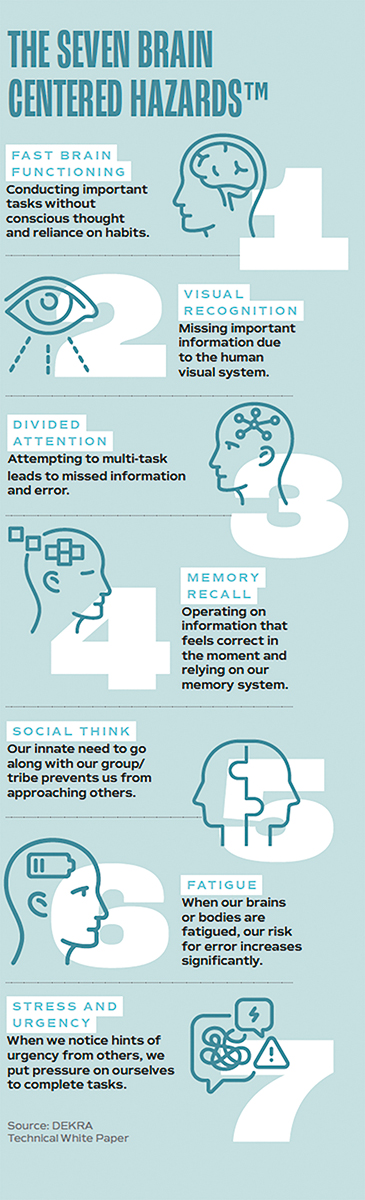
Safety consultancy Dekra highlights the risks of ‘brain hazards’ in safety critical situations.
This diagram is drawn from their technical white paper.