Session Recordings
Driver Safety Theatre
28th – 30th April 2026
Session 1: Tuesday 28th April, 10:30
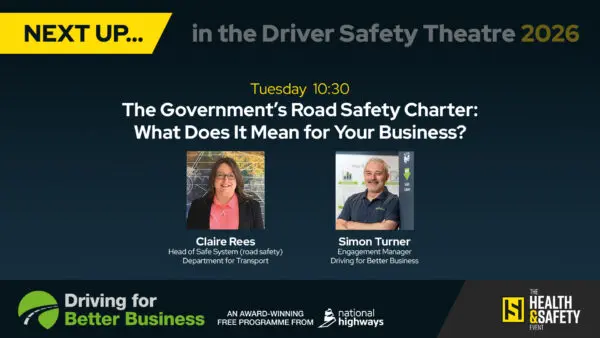
The Government’s Road Safety Charter:
What Does It Mean for Your Business?
Claire Rees Head of Safe System (road safety) – Department for Transport
Simon Turner Engagement Manager – Driving for Better Business, National Highways
The Government’s new Road Safety Strategy, launched in January this year, puts employers firmly in the spotlight. An estimated one in three road traffic fatalities, and over 30,000 injury casualties come from road incidents that involve someone who was driving or riding for work at the time. The Government’s response is direct – a pilot for a National Work-Related Road Safety Charter, aimed at reducing work-related road risk, improving safety outcomes, promoting organisational accountability, and encouraging good practice across industries.
But what does that actually mean for your organisation? In this session, Claire and Simon cut through the policy language to tell you exactly what’s coming, what’s expected, and what you should be doing now. Participation will initially be voluntary, but the strategy makes clear that regulatory measures will be considered if voluntary engagement does not deliver sufficient safety improvements. What will the government expect your business to do, and what are the likely consequences if you don’t comply? This is your chance to hear it straight from the source.
Session 2: Tuesday 28th April, 11:30
What Happens When You Start Measuring Driver Safety Properly?
Sergio Barata – VP EMEA, Netradyne (Chair)
Steve Mulvaney – Fleet Safety Manager, Canal & River Trust
Alison Moriarty – Executive Director, Risk & Operations, Beverley Bell
This session explores how better visibility of driver behaviour can transform the way organisations approach safety. Using the real-world experience of Canal & River Trust, with over 1,500 employees driving for work, the panel will discuss how AI-powered video and data insights are helping organisations move beyond assumptions and toward measurable improvements in driver safety, culture and operational performance.
Rather than focusing on theory, the discussion will look at what actually happens when organisations begin monitoring driver behaviour at scale; how the data is used, how drivers respond, and how safety leaders can turn insight into meaningful change across a complex fleet.
Session 3: Tuesday 28th April, 12:45
The Grey Fleet Gap: The Risk You Don’t See
Nigel Lawrence Strategics Partnerships Director – Applied Driving
Emma Turness Group Fleet Manager – Connells Group
Grey fleet vehicles account for a significant proportion of work-related driving, yet they’re often the hardest to control. Every year at the Health and Safety Event we field numerous questions on grey fleet so, this year, we’re giving the subject it’s very own session.
Join Applied Driving and Connells Group as they share real-world insight into the challenges of managing grey fleet risk, and how clearer policies, better engagement and practical interventions can help organisations protect drivers, reduce liability and improve road safety across their business.
Session 4: Tuesday 28th April, 14:00
Changing the Odds: Improving Safety for Young and Novice Drivers
Simon Turner Engagement Manager – Driving for Better Business, National Highways
Drivers aged 17–24 are three times more likely to be involved in a collision than other age groups, making young driver risk a critical issue for employers. This session will explore why your established induction and training programmes may actually be part of the problem, and we’ll demonstrate how organisations can better understand and manage the risks associated with graduates, apprentices and other young people who drive for work.
Drawing on real employer case studies, Simon will highlight the scale of the challenge and show how early, targeted intervention, tailored to young drivers, can deliver significant improvements in safety. Attendees will leave with practical insights into identifying risk, supporting young and novice drivers, and taking simple, effective steps to build a safer driving culture.
Session 5: Tuesday 28th April, 14:45
Culture on the Road: Why Driver Behaviour is Still the Biggest Risk
Prof Tim Marsh Managing Director, Anker & Marsh
Driver behaviour and safety culture continue to be the greatest challenges facing organisations managing work-related road risk – and the evidence comes straight from the health and safety profession itself. Drawing on fresh survey insights and decades of behavioural safety expertise, Professor Tim Marsh explores why culture matters, what really drives behaviour behind the wheel, and how organisations can move beyond policy to create meaningful, lasting change.
Session 6: Wednesday 29th April, 10:30
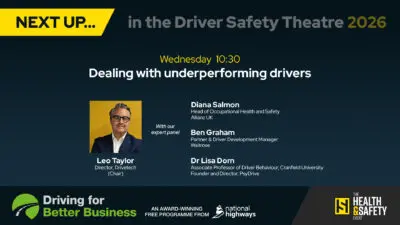
Dealing with Underperforming Drivers
Leo Taylor – Director, AA Drivetech
Diana Salmon – Head of Occupational Health and Safety, Allianz UK
Ben Graham – Partner & Driver Development Manager, Waitrose
Lisa Dorn – Associate Professor of Driver Behaviour, Founder of PsyDrive
Drivers with poor collision history, regular motoring offences, and those regularly caught corner-cutting or not following policies. It’s one of the most prickly subjects – how do we deal with these drivers and how do we get them to improve? This session will help you understand how to assess your drivers correctly and understand how to strike the right balance between encouragement, support and disciplinary action including suggested actions for each scenario.
Session 7: Wednesday 29th April, 11:45
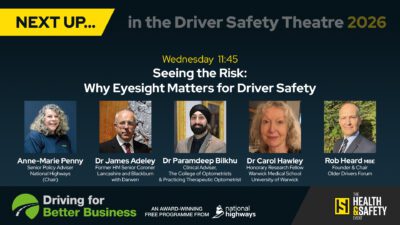
Seeing the Risk: Why Eyesight Matters for Driver Safety
Anne-Marie Penny – Senior Policy Adviser, National Highways (Chair)
Dr James Adeley – Former HM Senior Coroner, Lancashire and Blackburn with Darwen
Rob Heard MBE – Founder & Chair, Older Drivers Forum
Dr Carol Hawley – Honorary Research Fellow, Warwick Medical School, University of Warwick
Dr Paramdeep Bilkhu – Clinical Adviser, The College of Optometrists & practicing Therapeutic Optometrist
In April 2025 HM Senior Coroner Dr James Adeley issued a Prevention of Future Deaths notice to the Transport Secretary following inquests into 4 fatalities from 3 collisions where defective eyesight was the main factor.
Research shows that over 720,000 drivers nationally would fail a roadside eyesight test. Under legislation known as Cassie’s Law, drivers who fail a roadside number plate test could have their licence revoked on the spot. For managers, this highlights a significant driver safety risk as well as a service delivery risk. Clear vision is fundamental to safe driving, yet eyesight risks are often overlooked. This discussion will explore the real-world consequences of poor vision, the responsibilities of employers and drivers, and what organisations can do to reduce risk before incidents occur.
Session 8: Wednesday 29th April, 13:00
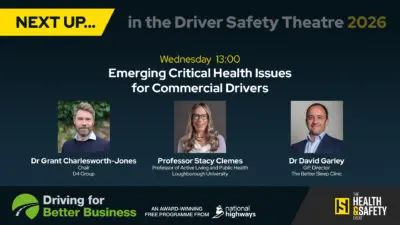
Emerging Critical Health Issues for Commercial Drivers
Grant Charlesworth-Jones – Chair, D4 Group
Dr David Garley – GP, Director, The Better Sleep Clinic
Prof Stacy Clemes – Professor of Active Living and Public Health, Loughborough University
As we get older, we know our health deteriorates. Commercial drivers are statistically well below average with worse health conditions and more co-morbidities. As they retire, they are being replaced by younger drivers, but new research is showing this younger cohort to have even worse health than those they are replacing. This is unexpected but critical information for those managing driver health as it leads to poor performance, service disruption and higher costs through staff absence and significantly increased corporate risk. The panel will discuss the emerging trend for poorer health in younger staff, causation factors and the research backing this up, the consequences of failing to address driver health, your corporate responsibilities in relation to driver health and key steps to help you start addressing the issues raised.
Session 9: Wednesday 29th April, 14:15
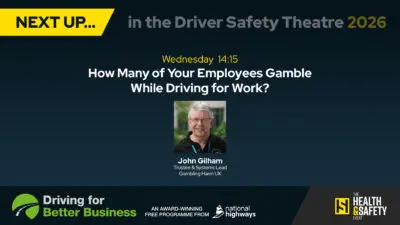
How Many of Your Employees Gamble While Driving for Work?
John Gilham – Trustee & Systems Lead, Gambling Harm UK
Almost 50% of UK adults gamble and 1.4 million of those gamble at a level serious enough to require support. A gambling disorder causes sleep disruption, emotional instability and compulsive mobile phone use – often while driving! Someone with a gambling disorder is also 5-7 times more likely to take their own life.
John will examine the relationship between gambling-related cognitive distraction and driver safety – impacting attention, reaction times, and decision-making on the road. The presentation highlights risk awareness and organisational considerations for supporting employees and promoting safer behaviours in driving contexts.
Session 10: Wednesday 29th April, 15:15
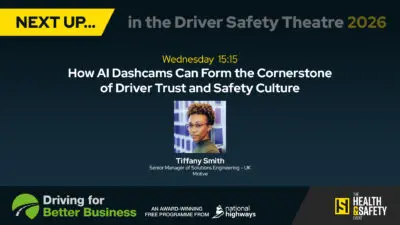
How AI Dashcams Can Form the Cornerstone of Driver Trust and Safety Culture
Tiffany Smith Senior Manager of Solutions Engineering – UK at Motive
In the race to adopt AI safety technology, many fleets find themselves drowning in “noise” rather than actionable “signal.” This session cuts through the buzzwords to explore why accurate AI is the essential foundation for driver trust and safety culture. Learn how to distinguish between meaningful alerts and false positives, and discover a practical, vendor-agnostic framework for evaluating performance through side-by-side trials to ensure your technology saves lives instead of just creating admin.
Session 11: Thursday 30th April, 10:45
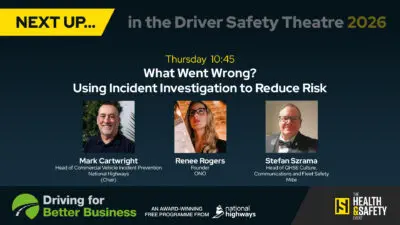
What Went Wrong? Using Incident Investigation to Reduce Risk
Mark Cartwright – Head of Commercial Vehicle Incident Prevention, National Highways (Chair)
Renee Rogers – Founder, ONO
Stefan Szrama – Head of QHSE Culture, Communications and Fleet Safety, Mitie
Behind every road incident is a chain of events and decisions that organisations can learn from. In this panel session, Mark Cartwright is joined by Renee Rogers and Stefan Szrama to examine how incident investigations can reveal the underlying factors that contribute to work-related road collisions. Through shared experience and discussion, the panel will explore how organisations can turn lessons learned into practical changes that help prevent future incidents.
Session 12: Thursday 30th April, 11:45
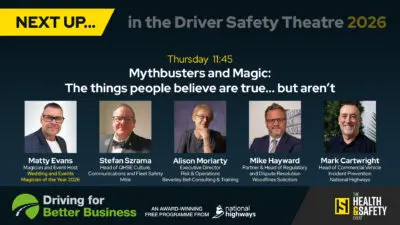
Mythbusters and Magic: The things people believe are true… but aren’t
Mark Cartwright – Head of Commercial Vehicle Incident Prevention, National Highways (Chair)
Stefan Szrama – Head of QHSE Culture, Communications and Fleet Safety, Mitie
Alison Moriarty – Executive Director – Risk & Operations, Beverley Bell Consulting
Mike Hayward – Partner & Head of Regulatory and Dispute Resolution, Woodfines Solicitors
Matty Evans – Magician of the Year 2026
Think you know the rules of the road? Think again.
This isn’t your average conference session. Hosted by Mark Cartwright, with 2026 Magician of the Year Matty Evans, our MythBusters session features live card tricks using a specially created deck of 52 cards, each one hiding a dangerous misconception held by drivers and employers across the UK.
With Matty’s sleight of hand revealing each myth, the expert panel delivers sharp, practical insight — challenging the assumptions that have quietly shaped driver safety culture for years. Because these aren’t fringe beliefs. They’re held by drivers and managers alike, reinforced by unspoken expectations and the daily pressure to just get the job done. Every myth busted comes with clear, actionable takeaways for both drivers and managers — not just what’s wrong, but what to do about it.
Come ready to be surprised. Leave ready to act with a free pack of our Mythbusters playing cards.