
What the new data from Driver Health Day tells fleet operators
by Simon Turner, Engagement Manager, Driving for Better Business
I spent Friday 4 September at Loughborough University for Driver Health Day, the centrepiece of the first national Driver Health Week. Having worked closely all year with the key people behind this event, I was already familiar with the issues but today was about releasing new research. As I sat on the Driving for Better Business stand listening to the presentations, even I was shocked – they were numbers that should worry anyone running commercial vehicles.
After the first three sessions, one thing was already clear. We spend a great deal of time and money making sure the vehicle is fit for the road. We spend almost none making sure the person operating it is fit to be in it. The evidence now says that gap is where a significant share of our collision risk actually sits.
The short version
- New Loughborough University data drawn from 87,517 driver medical records shows that only 25% of drivers have healthy blood pressure. 1 in 5 of those aged 31–45 and almost 1 in 3 of those aged 46–50 are hypertensive.
- Drivers who were dehydrated, or who slept under seven hours, reported measurably more near misses than those who weren’t.
- A Transport for London-funded review found UK HGV and bus medicals are the least rigorous of any safety-critical transport role in the UK, and behind almost every comparable country.
- A pilot wellness check programme found untreated diabetes in 8% of the drivers screened.
- The business case is now quantified: insurers are treating driver turnover as a lead risk indicator, and a single fatality linked to an undisclosed health condition can generate claims above £20 million.
Why driver health belongs on your risk register
Dr Grant Charlesworth-Jones – a GP and a barrister, founder of the charity Driving Better Health and the person who dreamed up Driver Health Week – opened the day with a thought-provoking analogy.
“Not knowing and understanding the health of a driver is no different to covering up your fuel or battery gauge and hoping to make it home today. You would never chance this – but this is exactly what we are doing with the health of our drivers.”
He described assessing thousands of drivers over many years and, in his words, “cataloguing a continued decline in their health at every visit.” Cheerful people, living to work, while the work quietly took years away from them.
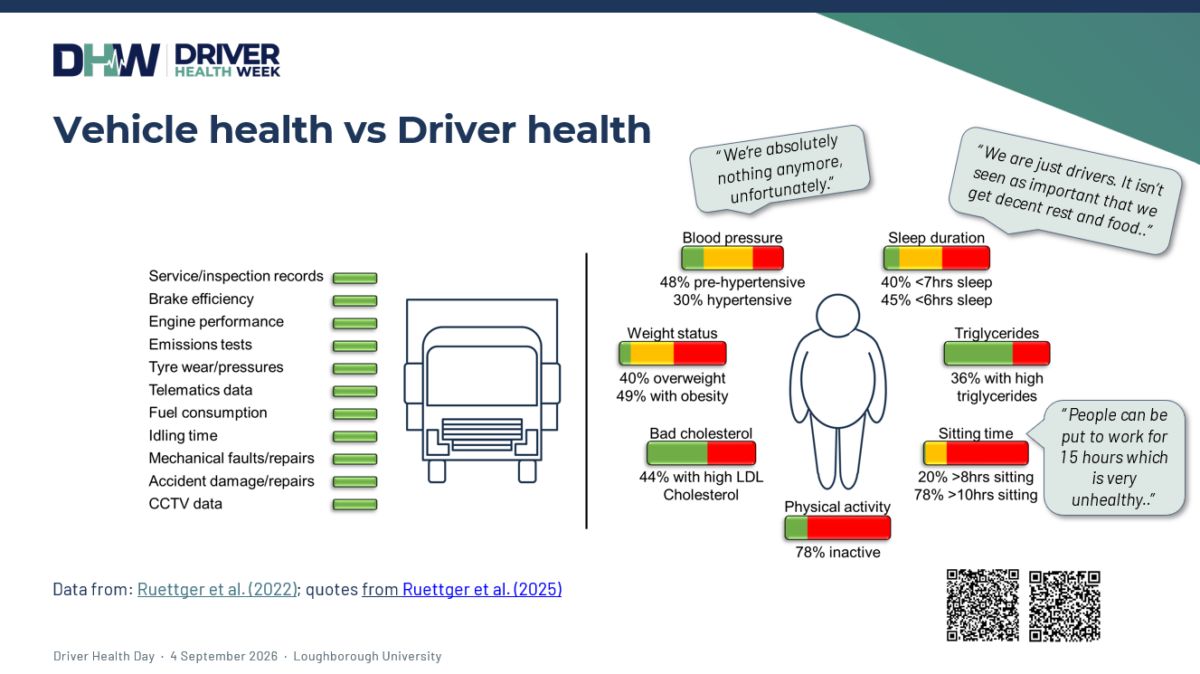
The road risk connection is straightforward. As Grant put it, the leading cause of incidents is not the quality-assured vehicle fresh off the production line. It’s the person behind the wheel, and we know far less about their condition than we do about the condition of their tyres.
What does the new data actually say about UK driver health?
Professor Stacy Clemes of Loughborough University delivered the keynote that underpinned the whole day, drawing on the largest global dataset on driver health. She used the event to release new findings.
The headline figure is shocking. Only 25% of professional drivers have healthy blood pressure. Three in four are outside the healthy range, and it worsens sharply with age.
From 87,517 driver medical records:

From a survey of 776 drivers (94% male, average age 59, ranging from 19 to 81):
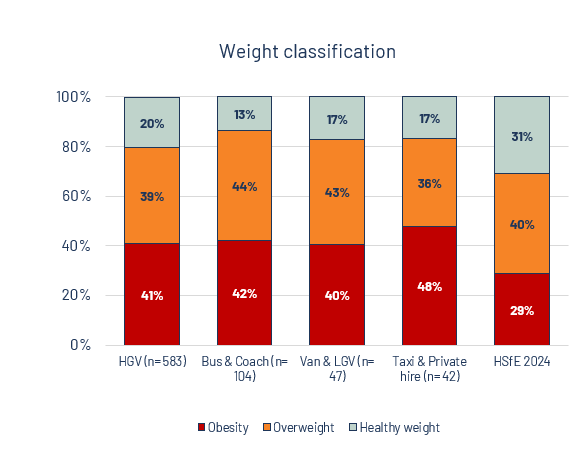
-
Only 13% of bus drivers are a healthy weight.
-
Fewer than 1 in 5 HGV, van and taxi/private hire drivers are a healthy weight.
-
Dehydrated drivers reported a near miss 30% of the time, against 20% for drivers who weren’t dehydrated.
-
Drivers sleeping under seven hours reported a near miss 28% of the time, against 22% for those sleeping more.
Those last two points represent a self-reported negative safety outcome directly related to two health issues that most operators do not think twice about.
The dehydration figure is particularly uncomfortable because it is largely something we have done to drivers rather than something they have done to themselves. Professor Clemes was direct about the cause: drivers deliberately limit what they drink because they cannot rely on finding a toilet. Roughly half of bus drivers in the research appeared dehydrated. That is a facilities and scheduling problem that is seriously increasing road risk.
Why are UK driver medicals weaker than every comparable safety-critical role?
This section of the day genuinely drew gasps from the audience. A TfL-funded review (Sayyah et al., 2026) compared the UK’s HGV and bus medical against pilots, air traffic controllers, seafarers and train drivers.
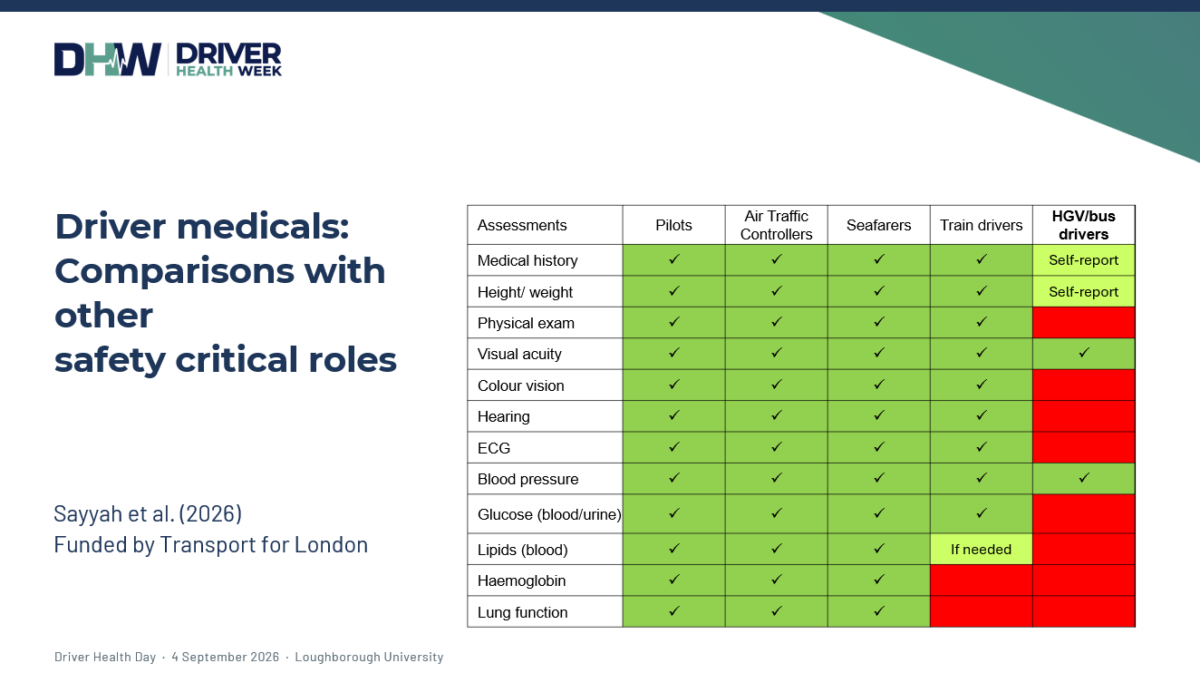
For those four roles, the assessment includes a physical examination, colour vision, hearing, an ECG, blood glucose, lipids, haemoglobin and lung function. For UK HGV and bus drivers, medical history and height/weight are self-reported, and of that entire list only visual acuity and blood pressure are actually tested.
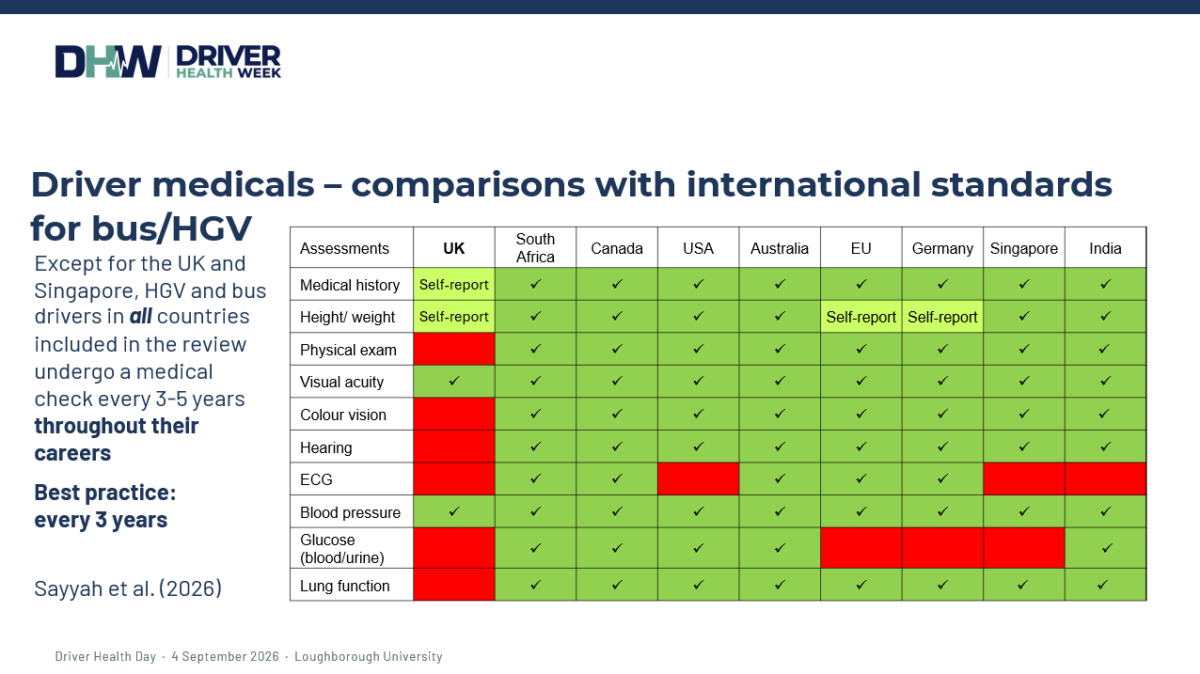
The international comparison is no better. Across South Africa, Canada, the USA, Australia, the EU and India, drivers have a medical every three to five years throughout their careers. The UK and Singapore are the two exceptions. Best practice, the review concluded, is every three years. Compare that to the UK where a newly qualified 20 year-old HGV driver will not have another medical until they are 45 – a full quarter of a century later!
Making the whole situation even worse was Grant’s claim that you can’t trust many of the medicals that are carried out. His own investigation suggests roughly a quarter of UK medical assessments are sub-standard, with fraud proliferating largely unchecked. The Doctors on Wheels case, where the director was jailed for four years in June after unqualified staff signed drivers off as fit in the back of vans, is one where publicity has ensured we can see what is going on. It would be reasonable to assume this is not the only instance.
What this means in practice is that a driver can hold entirely valid paperwork while carrying a significant, undiagnosed, safety-relevant condition. If your fitness-to-drive process stops at “we’ve seen the D4 certificate,” your process has a large hole in it. Compliance, in this instance, most definitely does not guarantee safety.
The conversation drivers aren’t having with you
The session that followed moved the discussion from data to culture, with Grant joined by panellists James Adcroft of Tesco, Lesley O’Brien OBE of Freightlink Europe, Dr Oli Chapman of the Society of Occupational Medicine and Andy Keane of AXA Insurance.
The recurring theme was fear. Drivers suppress health problems, physical and mental, because disclosure feels like a threat to their income. One example from the panel struck home: a driver with a newborn at home, severely sleep-deprived, who kept going because the priority was the load. There was an incident. It was preventable.
Lesley O’Brien spoke about this with a candour the sector needs more of:
“These drivers are our family. I’ve been in the situation where a driver has said he’d contemplated suicide. I’m not equipped to deal with that. We need the tools to support drivers properly.”
That is the honest position most operators are probably in. Dr Oli Chapman then explained “We need to create an environment that allows these conversations, but managers then need to know what to do.”
Both sides are vital. Psychological safety without manager capability just moves the distress from one person who can’t act on it to another.
Compliance is not the same as fit to drive
James Adcroft made the argument that will be most immediately useful to anyone reading this:
“Risk assessment principles aren’t applied to driving as well as they are in other areas of the business. Part of the solution is better risk assessment anchored in proper risk assessment principles rather than simply complying with what are obviously unsatisfactory regulations.”
A 15-hour day is legal. That is a different statement from “a 15-hour day is safe for this driver, on this route, in this weather, this week.” Everywhere else in a business we assess the hazard and control it. On driving, we check the shift against the rulebook and stop there.
The shift the panel called for looks like this:

The business case needs reviewing
Andy Keane of AXA gave the numbers that get boardroom attention. A single fatality involving a driver with an undisclosed health condition can generate claims exceeding £20 million. More interestingly, insurers are now taking driver turnover as a lead indicator of risk because a business churning through drivers is a business managing loads rather than people, and that will eventually show up in the claims data.
That reframes the business case conversation. Driver health spending should not be viewed as competing with safety spending – It is safety spending – and it can demonstrate clear ROI through improved driver retention and an improved insurance risk profile.
What actually works
Professor Clemes was clear that the research has moved past describing the problem.
Worksite wellness checks. A pilot with 111 drivers (average age 49, average BMI 29) found 88% with waist circumference in the increased or high-risk range, 76% living with overweight or obesity, 60% with elevated blood pressure, and nine drivers (8% of the sample) with untreated diabetes – that’s nine people driving for a living without knowing. The checks were designed with drivers, who asked for diabetes, cholesterol, mental health, sleep apnoea risk and kidney screening, plus clear feedback they could act on.
The SHIFT programme. Structured Health Intervention For Transport is the product of over a decade of Loughborough research, tested to clinical trial standards and delivered as a Driver CPC module. It produces clinically meaningful increases in physical activity. Crucially, SHIFT was co-developed with drivers and works within the realities of the job, rather than trying to ignore them. One operator’s HSQE director summed up the result as a healthier, happier and safer workforce.
Fixing the environment. When drivers were asked what they wanted, the list was simple and actionable: better facilities and restrooms, access to healthier food, revised policies on fatigue and working hours, onsite wellness checks and mental health support.
What’s coming next
Driving Better Health committed to a set of deliverables on the day: Driver Health Week as a permanent annual fixture; planned and pop-up health checks nationwide; mental health education modules for operators and drivers launching in early 2027, developed with doctoral-level psychologists and psychiatrists; an Approved Medical Assessor Scheme to tackle the integrity problem with D4 medicals; and a Health Hardship Fund for drivers stuck in diagnostic limbo, unable to drive but without a definitive diagnosis.
Five things to get you started
- Audit your fitness-to-drive process beyond the D4. If the certificate is your only control, you have a single point of failure with known integrity problems.
- Look at facilities and scheduling through a hydration lens. Where can your drivers reliably find a toilet? If you can’t answer confidently, you have a dehydration problem and, as per the data, a near-miss problem.
- Add sleep to your fatigue conversation. Hours-of-work compliance tells you nothing about whether someone slept. Ask.
- Give managers something to do with a disclosure. Encouraging drivers to open up without equipping managers to respond is worse than not asking.
- Treat turnover as a safety metric. Your insurer already does.
Andy Keane’s closing challenge was to go away and champion this internally, at the highest level you can reach. Lesley O’Brien’s was simpler but, I suspect, harder for many: get to know your drivers, and have proper conversations with them.
Grant explained that, five years ago, an industry leader told him the problems were all fixable within a narrow cost envelope if someone would just make a start. His ambition is that one day people will say they joined the transport industry for the health benefits.
On the evidence presented at Loughborough, that is a long way off but, for the first time, the data, the clinical expertise and the commercial incentive are all pointing in the same direction. We need to keep up the momentum, and build industry support, to ensure things start to change.
Frequently asked questions
Is driver health really a road safety issue, or is it a wellbeing issue?
Both, but the new Loughborough data makes the safety link measurable. Drivers who were dehydrated reported near misses at 30% versus 20% for hydrated drivers, and drivers sleeping under seven hours reported them at 28% versus 22%. Health markers are tracking with safety outcomes.
How many professional drivers have high blood pressure?
Loughborough University analysis of 87,517 driver medical records found that only 25% of drivers have healthy blood pressure. Prevalence of high blood pressure rises from 1 in 5 drivers aged 31–45 to almost 1 in 3 of those aged 46–50.
Does a valid D4 medical mean a driver is fit to drive?
It means they met the DVLA’s minimum standard at a point in time, using an assessment that relies on self-reported medical history and tests only visual acuity and blood pressure. It does not confirm ongoing fitness, and employers retain a duty of care in law that extends well beyond the certificate.
How often should professional drivers have a medical?
The UK is one of only two countries in the international review that does not require a medical every three to five years throughout a driver’s career. The review identified every three years as best practice.
Where can employers find free resources on managing driver health?
Driving for Better Business provides free guidance on managing driver health and your duty of care and on fitness to drive and medical conditions, along with a driver wellbeing toolkit for managers.

Simon Turner
Engagement Manager, Driving for Better Business