A drug-driving policy is not a control without testing
by Simon Turner, Engagement Manager, Driving for Better Business
According to the Office for National Statistics, 2.9 million adults aged 16-59 used an illicit drug during 2024 – that’s around 1 in 11. If it exists in society, it exists in your workforce so, if you are not testing your drivers for drugs, the likelihood is that you may well have a major road risk exposure you have never even considered.
That is the uncomfortable starting point for any employer whose people drive for work. According to D.tec International, around 60% of organisations have a drink and drug policy but fewer than 20% test against it. That means the vast majority of British employers are not doing what they need to do in order to properly manage the what is clearly a significant foreseeable risk.
What follows is what the current data actually says about the scale of the problem, why the official figures almost certainly understate it, and what a credible management response looks like in practice.
The short version
- DfT data to 2024 shows a 40% increase in deceased drivers with drugs detected over the ten years to 2024.
- During the police Operation Limit campaign in December 2024, 42.2% of proactive roadside drug tests returned a positive result – more than four times the positive rate for alcohol.
- 2.9 million UK adults used an illicit drug in the last 12 months. The heaviest-using demographic closely matches the commercial driver demographic.
- Around 60% of organisations have a drink and drug policy; fewer than 20% test against it. There is certainly an awareness gap but the bigger problem may be implementation.
- The government’s road safety strategy proposes interim disqualification – licences suspended on a positive test rather than on conviction. That could turn a legal problem into an immediate resourcing problem.
How big is the drug driving problem in the UK?
Let’s start with the official fatality data. New legislation enacted in 2015 made it an offence to drive while exceeding a specific limit for a variety of drugs in the blood, regardless of whether driving appeared impaired. The long-term trend in the ten years since, to 2024, show the number of deceased drivers with any drugs detected – illicit or medicinal – rose by 40%. That is a pretty clear direction of travel.
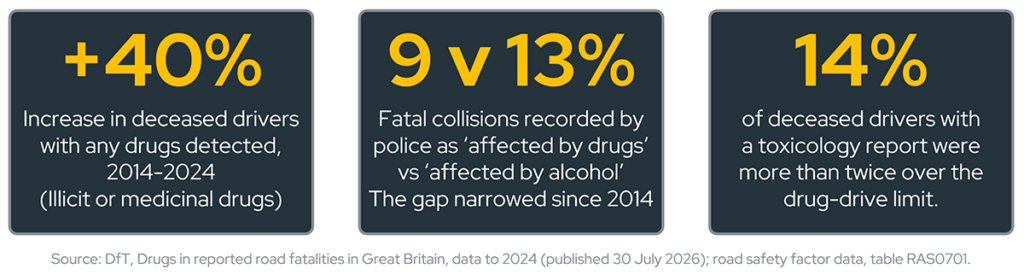
Alongside that, police recorded 9% of fatal collisions as affected by drugs, against 13% affected by alcohol – a gap that has narrowed steadily since 2014. But the police figure is a subjective assessment made at the scene. Where a toxicology report was actually produced, 14% of deceased drivers were found to have been more than twice the drug-drive limit.
Why the official figures understate the problem
Three gaps when recording these numbers mean they are a minimum and are, likely, significantly under-reported.
First, the driver has to have died. Fatality statistics depend on a toxicology report. A driver who kills someone else and survives will not generate one, and will not appear in these figures at all.
Two, the test has to happen. Blood testing is expensive, laboratory capacity is finite, and results that miss the six-month prosecution window are of no use. Where a case looks unlikely to be completed in time, the test may not be requested.
The roadside drugwipe only screens for cannabis and cocaine. Everything else – including most prescription and psychoactive substances – requires a blood test back at the station, which brings you straight back to the previous problem.
If the national picture is incomplete and under-reported because of gaps in testing, then surely the same logic applies inside your own organisation?
When police test for drugs, they find them
The clearest evidence of what systematic testing reveals comes from Operation Limit, the police enforcement campaign that runs each December.
Between 1 December 2024 and 1 January 2025 there were 58,675 roadside tests across the UK, producing 8,203 drink and drug driving arrests. That is roughly 264 arrests every day for a month.
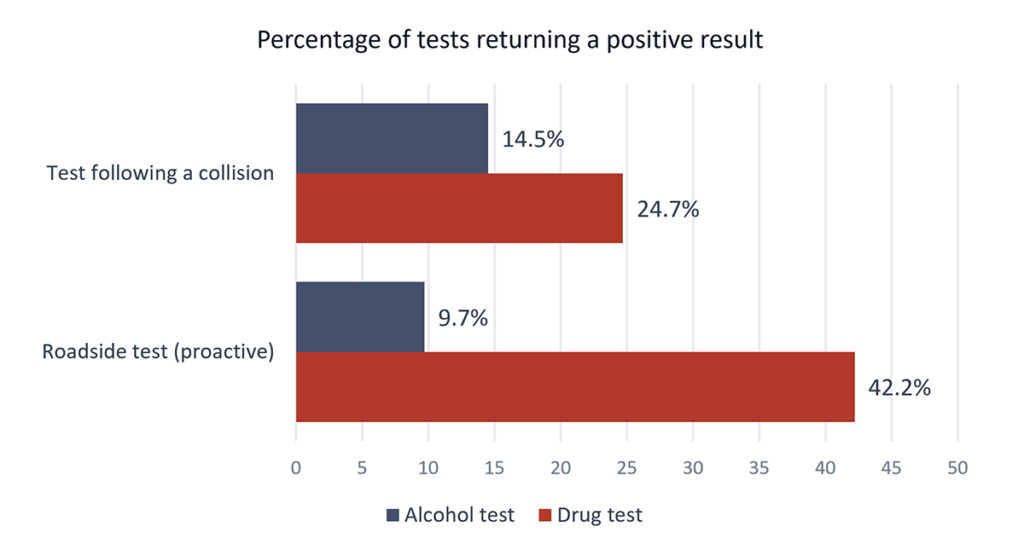
The positive rates are the part that should concern employers. Among proactive roadside stops, 42.2% of drug tests returned a positive result, against 9.7% for alcohol. Following a collision, 24.7% of drivers tested were positive for drugs, against 14.5% for alcohol.
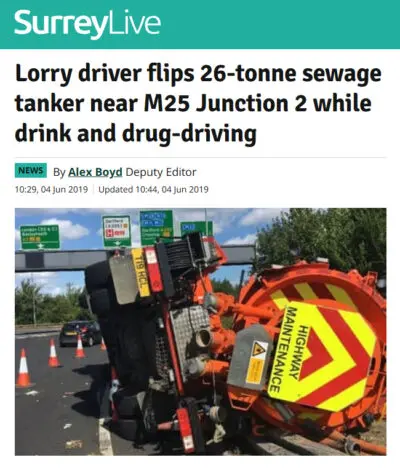
Courtesy of getsurrey.co.uk/news
Incident 2018
- 26-tonne sewage tanker on M25
- 41 year-old driver drink and drug-driving
- Driver jumped red lights
- Narrowly missed a petrol tanker
- Nearly ran over a female cyclist
- Crashed into a roundabout
Driver
- Jailed for 8 months
- 40 month driving ban
Employer
- £420,000 tanker written off
- Total business costs est. £900,000
While the national figures for 2025 have yet to be released, figures from individual forces for December 2025 point the same way. Merseyside made 460 drug-drive arrests, up from 360 the previous year and three and a half times its drink-drive total. Essex arrested three times as many drug drivers as drink drivers.
Operation Limit does not create this behaviour for one month a year – it simply makes it visible. Those same drivers are on the road all year round. The difference is that nobody is looking in February. Or May. Or August.
If it exists in society, it exists in your workforce
ONS survey data shows 2.9 million adults aged 16 to 59 – around 1 in 11 – as having used an illicit drug in the last 12 months. An estimated three million workers attend work under the influence of drugs or alcohol.
Prevalence is highest among men aged 20 to 39. That maps closely to our commercial vehicle driver population.
Overall illicit use has been broadly flat for years, at a persistently high level. What is changing is the use of prescription medication, which is rising, and the rate of detection, which is rising with it. The exposure has always been there. What is increasing is the likelihood that it surfaces – in an enforcement stop, a collision investigation, or in a coroner’s court.
Why the real gap is implementation, not awareness
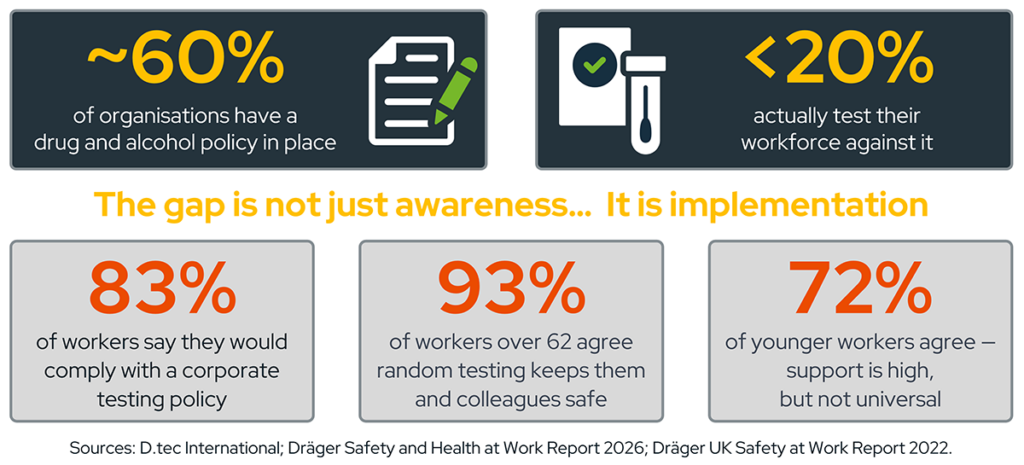
Around 60% of organisations have a drink and drug policy. Fewer than 20% carry out any testing against it. So roughly 40% of employers have not taken the first step at all, and another 40% have written the policy and stopped there.
It is not employee resistance holding this back. 83% of workers say they would comply with a corporate testing policy, and 93% of workers over 62 agree that random testing keeps them and their colleagues safe. Support runs lower among younger workers, at 72%, but that is still close to three quarters in the age group most likely to be using.
The legal exposure of that middle group of employers – those that created a policy but are failing to test against it – is worth examining. In a 2020 prosecution following a double fatality, Renown Consulting was fined £450,000 with £300,000 in costs, a total of £750,000. The case concerned fatigue rather than drugs, but the principle is perfectly relevant: the company was not penalised for failing to have policies. It was penalised for failing to implement the policies it already had.
A written policy that is never tested against is not a control. In the event of a serious incident, it is evidence of what you knew you should have been doing all along.
What good looks like
A credible programme has four stages.
- First, policy sets the expectation in writing for everyone.
- Second, education builds the awareness that allows people to comply.
- Third, a credible chance of detection is enough to change behaviour.
- Fourth, actual detection turns the policy into something real.
The fourth stage is the one that does the work, and it is the one most commonly missing. Deterrence only exists if detection is a genuine possibility.
What should a drink and drug policy contain?
Seven components, each of which should be explicit rather than assumed.
- Purpose. Why the policy exists: duty of care, safety, and licence to operate.
- Scope. Who it covers, when and where. This is where many policies fail. Agency drivers, subcontractors, and staff on call are frequently outside the wording, and so is the use of prescription medication, which is a growing share of the risk.
- Responsibilities. Named owners are required – line manager, HR, supervisor, and a board-level sponsor.
- Prohibited behaviours. Be explicit about possession as well as use, and being under the influence.
- Testing procedures. When, how, which substances, by whom, and on what basis consent is obtained. In practice, written informed consent is normally established through acceptance of the policy itself.
- Consequences. Proportionate, consistent, and applied identically at every site. Remember to treat staff fairly and as human beings. A positive test can be the result of deeper personal problems for your driver.
- Support. An employee assistance programme, occupational health, and a defined route back for anyone who comes forward.
Most organisations run an amnesty when a policy is introduced. The stronger approach is to keep that door open permanently, with conditions attached. One operator I spoke to recently had a driver disclose a problem voluntarily. They valued him, so they supported him – on the basis that he would be tested every working day from that point on. He accepted immediately. The alternative was being unemployed and unemployable, and he has been loyal ever since.
After that, the position is zero tolerance and dismissal for gross misconduct.
How much screening and testing counts as a deterrent?
This is where a lot of well-intentioned programmes can fall down. Screening only 10% of your workforce a year means the average employee can expect to be tested once a decade and that’s not a credible deterrent. The screening regime has to be substantial enough that detection is a realistic prospect, not a remote one.
For those not familiar, screening is the fast operational check – a swab or drug wipe – that tells you whether there is something to investigate. Testing is the confirmatory laboratory analysis of a blood sample that follows a non-negative screening result. Screening on its own isn’t substantive enough to act on unless the driver voluntarily confesses.
Good practice screening covers four situations:
| When | Why it matters |
|---|---|
| Pre-employment | Establishes a baseline and sets the standard from day one |
| Random, through the year | The only element with genuine deterrent value |
| On reasonable suspicion | Where there is documented cause |
| After any incident | Removes ambiguity from the investigation |
Use police-specification devices, and confirm every non-negative screening result with a laboratory blood test before any decision is taken.
What should you do after a non-negative result?
What happens in the hours after a non-negative screen determines whether your policy has authority or not.
- Verify. Right person, right date, chain of custody intact.
- Confirm. Send for laboratory analysis. A screening result is an indication, not a finding.
- Stand the driver down. Do this immediately, but discreetly. Frame it as administrative leave pending investigation.
- Do not pre-judge. Give the driver a fair opportunity to explain. Prescription medication, contamination and administrative error all happen.
- Protect the data. Test results are sensitive personal data and should not travel beyond those who need to know.
There is a cultural dimension here that matters more than the individual case. If a clearly guilty driver is retained because dismissing them would leave you short-staffed, every other driver learns what your policy is actually worth. The decision you make under operational pressure is the one that sets the standard.
Why the law could change
The government’s road safety strategy, published in January 2026, launched a consultation on three proposed changes to would have a huge impact on employers.
Interim disqualification. At present a driver who fails a roadside test keeps their licence until the case reaches court, which can take months. The strategy proposes immediate suspension at the point of a positive test.
Faster drug evidence. The possible introduction of new Home Office-approved methods, including evidential saliva testing, capable of detecting a wider range of substances at the roadside.
Penalties under review. Disqualification periods and sentencing for drink and drug offences may be strengthened.
The practical implication is a significant business resilience question. Read the prevalence data at the top of this article, then consider what happens if a driver who tests positive is off your roster that same afternoon rather than several months later. If you are carrying more exposure than you realise, that is the moment you will find out.
Three things to do first
- Read your policy. Does it cover prescription medicines? Agency and contractor drivers? Does it provide for any preventative testing at all? If you do not have a policy, that is the priority.
- Ask how you would know. If the honest answer is that you would find out when something went wrong, you have identified the major gap.
- Start sharing the material that already exists. The Department for Transport’s THINK! drug driving campaign provides free films, images and posters. Putting them into your driver briefings is an easy step
The THINK! campaign is the first dedicated drug driving campaign in a decade, aimed at drivers under 30 – the group in which around four in ten drug-impaired drivers sit. Research found 32% of that audience think it is acceptable to drive after taking drugs if they “feel fine”, and 46% of young men know peers who do it. The campaign has been running throughout September and it will be running again through December in support of this year’s Op Limit.
Frequently asked questions
How common is drug driving in the UK?
During the police Op Limit campaign in December 2024, 42.2% of proactive roadside drug tests returned a positive result, against 9.7% of alcohol tests. Across the month, 58,675 roadside tests produced 8,203 drink and drug driving arrests – around 264 a day. Separately, DfT data shows a 40% increase in deceased drivers with drugs detected over the ten years to 2024.
What is the difference between drug screening and drug testing?
Screening is a fast operational check, usually a mouth swab or drug wipe, carried out at the workplace or roadside. It indicates whether a substance may be present. Testing is the confirmatory laboratory analysis of a blood sample that follows a non-negative screening result. A screening result alone should never be the basis for a disciplinary decision.
What should a workplace drink and drug policy include?
Seven elements: purpose, scope, responsibilities, prohibited behaviours, testing procedures, consequences, and support. Scope is the most commonly deficient – agency drivers, contractors, on-call staff and prescription medication are frequently omitted.
Can an employer test employees for drugs?
Testing requires written informed consent, which in practice is normally established through acceptance of the drug and alcohol policy as a term of employment. The policy must be clear about when testing happens, which substances are covered, and how results are handled. Take your own HR and legal advice on your specific circumstances.
How often should employers test drivers for drugs?
Often enough that detection is credible. Testing 10% of a workforce annually means an individual is tested roughly once a decade, which has no deterrent effect. Good practice combines pre-employment screening, random screening through the year, screening on reasonable suspicion, and screening after any incident.
What happens to the employer if a driver is convicted of drug driving?
Beyond the direct costs of losing a vehicle and a driver, insurers are obliged to meet third-party claims but will generally decline your own losses and may pursue you to recover what they have paid out. For operators, police may refer the case to the Traffic Commissioner, who will ask what policies and procedures you had in place to manage driver impairment.

Simon Turner
Engagement Manager, Driving for Better Business